
How a Douglas College program ‘reboots’ students by helping them map routes to their dream jobs.
This article was published in The Tyee.
Katie Hyslop Katie Hyslop is a reporter for The Tyee. Follow them on Bluesky @kehyslop.bsky.social or send story tips to khyslop@thetyee.ca.
When politicians talk about getting people into training to fill the job vacancies of the future, they typically focus on growing industries and job sectors, available college and university seats and potential gross domestic product growth.
Peter Wilkins doesn’t care about any of that.
When he welcomes participants into Douglas College’s Reboot Plus program for 17-to-24-year-olds without a high school diploma or career path, all Wilkins wants to know is: what do these young people want to be when they grow up?
Unlike other workforce development programs reconnecting people to education or work, “there’s no idea that people are in this program to get a job immediately,” said Wilkins, Reboot Plus’ faculty research liaison at Douglas College.
“The idea is to get people to see what they want to do, look at the educational pathways that are required for what they want to do, the schools required and have that be on the horizon.”
Reboot Plus introduces participants to the post-secondary experience, while encouraging them to explore the career they want and the steps they must take to get there.
This includes the opportunity to interview someone working in their desired profession.
“If they wanted to meet a lion tamer, if they wanted to meet an executive banker, our contractors would go out to identify lion tamers or executive bankers,” said Trevor Van Eerden, principal at PEERS Employment and Education Resources, which co-developed Reboot Plus and matches participants with professionals.
At the end of the 16-week program, every young person leaves Reboot Plus with a path mapped out for getting their dream job, and a better sense of what a post-secondary education has to offer.
The data is preliminary, but it looks like Reboot Plus’ “hope-centered career development” approach is paying off.
Since 2020 the program has achieved a 92 per cent completion rate and 66 per cent of surveyed participants have completed high school since finishing Reboot Plus.
As a result, expansions of Reboot Plus into Fanshawe College in Ontario and College of the North Atlantic in Newfoundland and Labrador are now entering the “replication phase” to see if the program can succeed without hands-on direction from Douglas College.
“Can we replicate the success we had, if we offered it on our own?” explained Perry White, lead instructor for the Reboot Plus program at the Stephenville, NL, campus of College of the North Atlantic, which offers Reboot Plus.
“Which would mean now after we do it this time, we need to go out and try and find funding and different ways to fund the program.”
It’s the first test of whether Reboot Plus has potential for success across Canada, says Tricia Williams, director of research, evaluation and knowledge mobilization with Future Skills Centre. The centre funds workforce development research, pilot projects and evaluations, including almost $6.5 million for Reboot Plus since 2020.
“We have a theory that we don’t necessarily need more money, but we need money to go into programs and interventions that are getting results,” she said.
“It’s not enough for people to finish training programs, they have to actually lead to jobs and be aligned with labour market needs.”
Finding a path for the NEETS
White knows first-hand what it’s like to have a rough time transitioning from high school student to responsible adult.
“There was no big dramatic quit or anything, I just stopped going” to high school, said White. “I ended up getting a part-time job pumping gas, and then I found a program here at the college for people who didn’t finish school and wanted to go back.”
Today White, who went on to earn three bachelor’s degrees, a master’s and a career as an alternative school principal, is working with young people who are just like he was at their age, in the same classroom he sat in decades ago to finish high school.
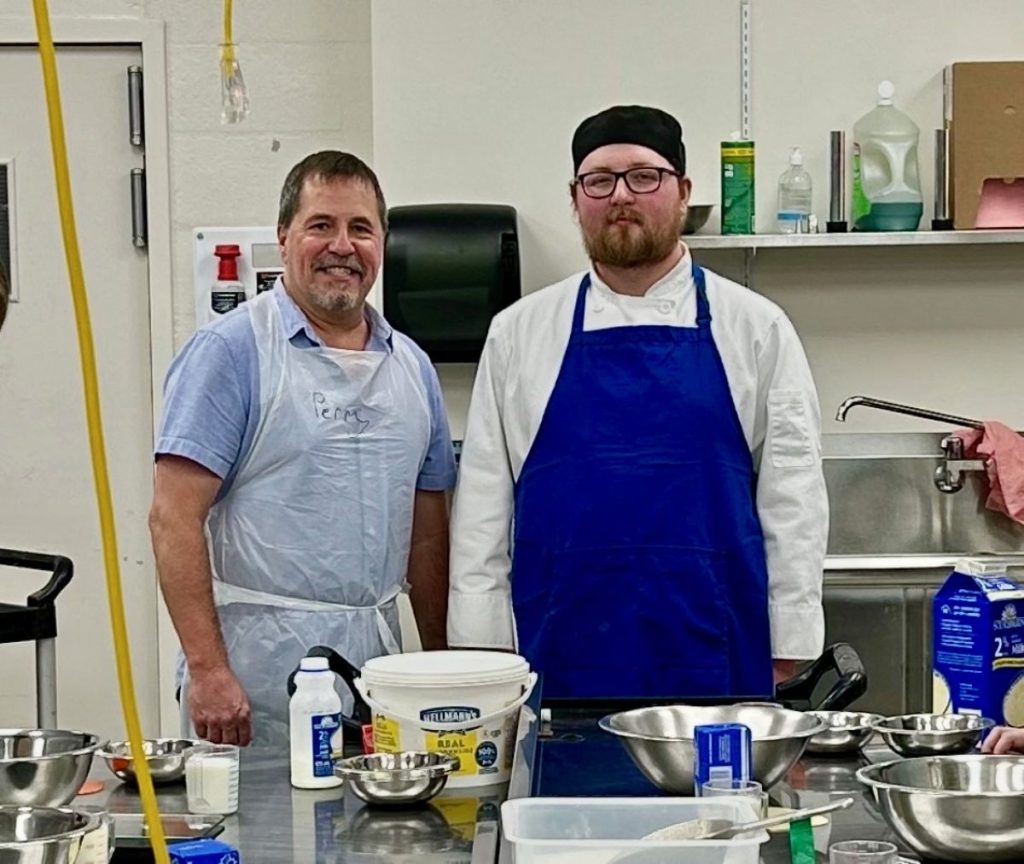
Reboot Plus instructor Perry White, left, poses with former student Jacob Hancock. White says when Hancock was a Reboot Plus student he attended a baking class, which led to him enrolling in a baking and pastry arts program at the College of the North Atlantic. Photo via Perry White.
White’s experience goes to show that “not everybody knows exactly what they want to do or have a very clear path, and you can still find your way and find things you like to do,” he said.
Douglas College’s Wilkins doesn’t want to connect young people with just any career path through Reboot Plus. But he isn’t naive: he knows people are better off in general when they have a post-secondary education.
According to Statistics Canada, young people without a post-secondary credential have the highest unemployment rates, especially if they didn’t finish high school. Average annual incomes for people with a bachelor’s degree or higher are almost double that of their peers who have no high school or post-secondary diplomas.
According to the Future Skills Centre, which operates out of Toronto Metropolitan University, 11 per cent of youth in Canada are what is known as NEETs: not in education, employment or training.
NEETs are more likely to drop out of high school, have poorer economic outlooks and are disproportionately Black, Indigenous or people of colour.
“There’s a very notable NEET problem,” Williams said. But Canada hasn’t “had much of a policy response to that, other than to say we’re going to subsidize work opportunities for people.”
For young people who struggle to finish high school for whatever reason, taking “that leap from high school — which you hate — to post-secondary is not one that you’re sure you want to make. And also seems kind of impossible,” Douglas College’s Wilkins said.
“The problems that these youth have are not problems of intelligence. Often it’s the opposite. It’s more like social things, and the conformity that high school demands, that causes them difficulty.”
Reboot Plus gives these students a taste of college without the academic pressure or tuition fees. Participants have a two-hour Reboot Plus class twice a week on campus where they work on soft skill building like communication, working with others and articulating what they want for their futures.
“A lot of it is for students to learn about themselves, and a lot of it is about going through information and basically trying to create filters in terms of trying to find out what information is most pertinent to them,” said White.
They also get student IDs and have use of student amenities like the library, gym and cafeteria.
“The group, by and large, is very anxious,” Wilkins said, adding a lot of the Reboot Plus participants at Douglas College are newcomers to Canada, identify as LGBTQ2S(IA)+ and struggle with depression and anxiety.
“How do you take someone who can’t get out of bed or is afraid to have a conversation with somebody else, how do you help them into the world?”
Upfront cost for long-term savings
While Reboot Plus explores what careers young people want, the local job market, impact of technology changes and overall future of the young person’s career choice are also explored.
For example, the adoption of AI large language models, like ChatGPT, put the future need for careers like paralegal into question.
“You would want to say, ‘Okay, what does that look like in the current landscape?’ rather than just saying, ‘Yes, go be a paralegal,’” said Future Skills Centre’s Williams.
Reboot Plus is free for participants, and at Douglas College funding covers participants’ transit tickets and food on class days.
Participants are connected to Reboot Plus through their partnerships with local school districts and immigrant settlement organizations.
Some of the professionals the young people meet with to talk career paths work at the college, too, giving Reboot Plus participants a tour of the campus kitchens, science labs and workshops.
“Yesterday we did a cooking class with the chef here at the college,” said College of the North Atlantic’s White, adding it was an immersion experience where the young people learned about all the different settings a cook could work in.
“Then the questions afterwards would be, ‘Is this something you can see yourself doing?’…. And if not, why not? And use that information to help them make other decisions.”
The Future Skills Centre will also gain from the Reboot Plus expansion by researching current and future participants’ outcomes. This includes an agreement with Statistics Canada and Reboot participants to monitor their future tax returns.
“So we can study into the future what happens to these people, and compare with other people who didn’t go through the program,” Williams said, adding an official report on Reboot Plus participants’ outcomes is due later this year.
Projects like Reboot Plus are expensive to set up, Williams says. But they’re cheaper than offering a lifetime of unemployment support, she says.
“They’re heading for very low-wage jobs or difficult lives, that’s the trajectory these young people are headed on. And we’re trying to interrupt that trajectory and get them onto a pathway to ‘reboot’ their lives,” Williams said.
“We also need that as a country: we need workers, we need people. We have one of the lowest birth rates, we’re reducing immigration. We need people to have the skills we need in our labour force.”